


Compensation and Benefits
Compensation in the Workplace
Let’s talk about it. Compensation refers to the total monetary and non-monetary rewards an employee receives in exchange for labor or work completed. It’s a combination of wage (hourly or salary), any variable incentives (any type of bonus, commissions, etc.), and what are called indirect benefits (health/medical insurances, retirement plans, paid time off, etc.). When senior management or HR talk about, we call it ‘total rewards’, which means everything an employee receives by working for that employer.

Total rewards framework includes the following: compensation, benefits, perks, recognition, career development, and work-life balance programs. Based on the company these varies, some organizations have top of the line packages because their industry can support it, example Google and others very limited, like a company with five (5) employees because of their industry and financial health of the business. It’s important to understand how much an employee is monetary supported by their company.
Payroll and Benefits take up to 50% of gross revenue, it’s the largest operating expense a business. It’s why employees are referred to as Human Capital or Golden Capital because that’s how valuable they are to the business’ success. Employees bring skills, knowledge, performance, and experience.
All workers have choices on what their goal is for work, what that job looks like, what the compensation level is, what industry, skilled or unskilled, trades or college, physical or mental work, and more. It’s effort over excuses, if you don’t like the work or wage constraints of job in a specific industry (ex. Fast food, Laborer) because you don’t have a high school diploma or GED, then focus on getting those and level up to have more choices. If a single parent with three little ones can work full-time and take college courses to move up the employment opportunities ladder, everyone can.
Asking for a Raise
Let’s talk about it. Starting with a story. I was facilitating a re-training for foreman, the reason they were all here was because then weren’t meeting expectations, it was the last step before a decision would be made. Demotion or termination. After completing a train-the-trainer on how to train, they were asked to submit questions in writing which would be used for the next session. There were seventeen (17) in attendance, two (2) didn’t ask a question and fifteen (15) all asked a variation of how to get a raise. The company they worked for didn’t have a true performance review annually but did give everyone a 3% increase with top performers 5%.
Build Your Case
If you want to ask for a raise, before you drop the ‘I want a raise’ to your manager, which is an unsupported assertion, don’t. If you drop it thinking your manager or HR is going is going to automatically gain access to your thoughts and reasons, it’s not going to happen. It’s a harsh truth. If you want to get a raise, then you must build a case for it. It doesn’t matter about the industry or size of the company – all require a case to be built.
Let’s talk about it. There are five (5) necessary pieces:
-
Compensation Range Research – every job role, based on the duties and responsibilities, and title has a compensation range to it. There are companies who go outside the range, either lower or higher. There are companies that have ‘pick your title’ as concept, don’t use that title in the search. Understanding your industry is important.
-
Compensation data is out on the internet, I’d recommend Salary.com, their data comes from HR driven data. Glassdoor and Payscale are good, and if you are in the tech industry use Levels. Be honest with your skills and experience and your geographic location.
-
Once you understand the range for your role, industry, and where you are located. Compare it to your current wage.
-
Question: Is the amount you want, within that range?
-
Yes, it looks like it is -or- No, but I’m committed to going for it and asking for the amount I want– proceed!
-
No, I’m being paid over the maximum for this role:
-
It’s time to talk to my manager about how to grow into another role and responsibility that has the money I’m looking for.
-
-
-
-
-
Employer’s Financial Health – it’s not necessary to gain access to the company’s profit and loss statements to have a basic understanding if the organization you are working for is financially healthy. Don’t focus on what the CEO is earning, focus on the day-to-day stuff. Are hours being cut for everyone? Payroll issues? Are vendors complaining it’s taking over 120 days to be paid? No more free snacks or lunches? Bill collectors? Manager states money is tight.
-
If the company is struggling with their financial stability, then the chances of success in getting that raise go down considerably. It’s not impossible, but it might not be good timing, or it might be short-lived with layoffs occurring in the future.
-
It’s also important to review the company handbook for pay raise policies outside the normal review cycle or wage increases. Make sure you understand it and any parameters with it.
-
Question: Is the company financially stable? Do you understand the policy?
-
Yes, it looks like it is financially healthy and within policy -or- No, but I’m committed to going for it regardless– proceed.
-
No, there are money struggles and no handbook policy about raises:
-
Consider looking for similar role at another company for the wage you want.
-
-
-
-
-
Build Your Case – you have the data about the wage range and determined the company is financially stable and understand the policies associated with wage increases. Now, it’s all about quantifying your work performance, training, and improvements from any type of infractions or issues on file. All you will be doing here is gather the best reflection of your work performance, with any training and what you have improved successfully.
It’s a handful of bullet points. Do not print anything documentation (metrics, reports, project notes, emails, performance reviews, etc.). Do not overthink this, the points must be clear and concise, nothing more. Do not write a book (one page).
-
-
2 to 5 bullet points of accomplishments
-
1 to 5 trainings with a statement of how it was adaption or your main take away learned.
-
1 to 3 improvements or what you want to improve on related to your performance.
-
-
Performance Practice – it’s the critical piece out of all of this, and where the fumble happens. Avoid the fumble. Write out in 2-5 sentences max an opening script and walk through your bullet point at a normal pace in your normal calm tone. Do not rush it.
The script is for you, not your manager. It’s your ask, but in front of your manager it’s a conversation. Which is why you need to practice it uninterrupted in front of a mirror, on repeat until the butterfly flutters and nervousness stops.
You can do this. It’s not about a flawless performance worthy of a Hollywood reward; it’s about you being comfortable to walk the request all the way to the end at the beginning of the meeting with your manager. The work is done. The case is built. You are ready for the delivery of information.
-
The Meeting – request a private meeting with your manager. Let them know the reason “Discuss my career or growth path and review my performance to date”. This varies by industry, a small HVAC company where the manager does things on the fly is radically different from a formal large organization. This conversation is not for an audience, therefore move it away from other people to a quiet space.
Go into the meeting with positive thoughts. You’ve done the work, so answering question your manager will have should be easy. Questions aren’t an automatic or invisible ‘no’; dialog is good. Don’t listen for the ‘yes’, listen to what is being said and how you fit into it.
Outcomes:
-
-
You get some or all the money you want.
-
Manager was impressed, but (given budgets, needs to check), etc.) not able to meet that expectation currently.
-
Hold your composure, the way you react will be remembered longer than the positive impression made by being prepared.
-
-
Manager gives an immediate ‘No’ and explains why.
-
Hold your composure, the way you react will be remembered. If your manager responded to the reasons, listen. Especially if it’s about improvements, they see currently that were not addressed in your case.
-
-
Examples:

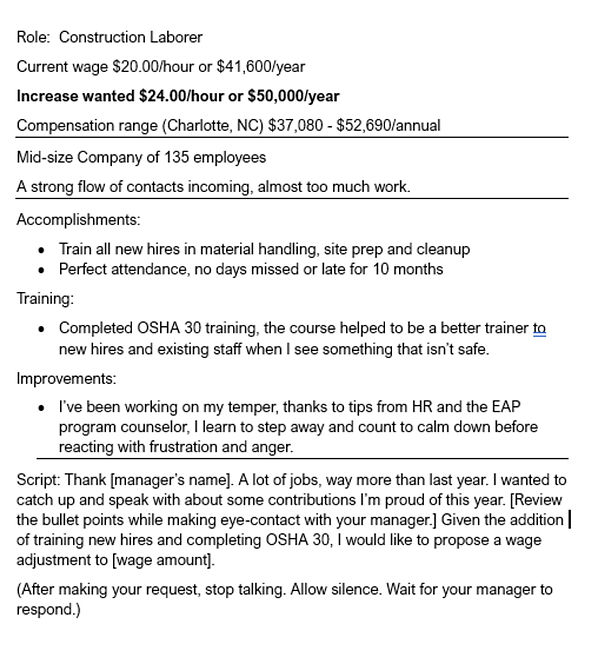
The key to having the best chance at a pay increase outside of a review cycle, promotion or moving to a new role, is to articulate your work to show your worth in your own words. Show that you can accomplish your work without errors. Show that you recognize areas of improvement and improve them. Don’t be an imposter.
The expectation that your manager should know your contributions and automatically give pay increases, promotions, and new job opening, and you shouldn’t have to do any of these ‘extra’, is flawed. Even the best manager is just barely treading water, with their own workload and needs their direct reports, while chasing problems. That thought is impractical. Advocate for yourself and listen to the reason why you didn’t get the increase. If it is financial, that could turn around in 3, 6, or 12 months. If it because other work, behaviors, or concerns need to be improved; then improve on them. Your reaction to the ‘no’ or adversity will speak volumes to your manager. It tells them your part in this meeting was an act.
End of the Story
Out of the fifteen (15) foreman, six (6) used the ‘Build A Case’ and were very successful in pay increases, three (3) increased more than they asked. They were more engaged and felt empowered when they understood the reasoning. Understood how simple it was to be clear and concise. They happily pass along the ‘Build A Case’ to spouses, partners, children, and anyone else. Even when you don’t get an immediate yes, you know what is needed to get it next time. For those who worked for businesses that weren’t financially stable, they understood they had a choice: stay or change jobs.
Of the nine (9) remaining, two (2) decided to ask for more responsibility and be promoted with an increase in pay. They were both terminated when after the wage adjustment they refused to do the additional responsibilities. Of the remaining, it was a mix of demanding more money (because others received raises), threats to walk off, poor performances and behaviors where they either quit or were terminated.
Don’t Give a Performance for a Pay Increase
Let’s review examples on what to avoid:
-
Michelly, Poor Performing Employee – failing at the end of a Performance Improvement Plan (PIP), after multiple retraining on the basics of her role. Could only do 25% of the job. Absolutely refused to learn beyond the surface. Compliance errors. Without critical understanding, she wasn’t tracking for any type of pay increase. She was heading for termination once her manager returned from medical leave.
-
Taking advantage of her manager’s absence, she spoke with the CEO about being offered another job and needed to let them know by Friday. On that same day was on an hour call with her manager because she needed help – never mentioned the opportunity.
-
At the CEO’s request her manager came in to meet with her. Michelly stated that she took the job and just wanted to talk about what she wanted to grow into, which oddly was the role she was in and could not perform. Let them know she would stay for more money.
-
Given her role, her system access and working with confidential information warranted that her employment would end that day. Her manager explained the reason, also gave advice on professional behavior in this situation and it was odd that she didn’t mention it at all during our meeting.
-
Important to note: this behavior was done in her internships and at another company. She lied about the offer and the job; the company sent a generic recruiting message via a platform. Michelly left more than a handful of big issues that come will fines.
-
-
Lionel, Long-term Employee – started in the warehouse still in the warehouse. Very stuck in the old ways. Would argue any point, valid or not, real or imaginary, when a change was made. He loved the manual ways because he could move slow and extend hours. Always complaining the ‘they’ didn’t give him this job or that job, always overlook him. No initiative to even inquire.
-
Inflation and costs were rising, asked for a meeting with management. Handed over receipts from gas stations, grocery stores, fast food, and more. Each wrinkled and looked like it was picked out of the trash. Wanted to be reimbursed because he wasn’t making enough money and the company owed him for his years of service.
-
Important to note: an employer doesn’t have control over inflation and rising costs, collectively we all feel the brunt of increasing costs. Employers do cost of living pay adjustments, but it’s not on a weekly/monthly basis. Generally, it’s once a year and if the company can afford it.
-
-
Daniel, Long-term Employee – after a decade, he was promoted to another department to do higher level work. Big increase and at completion of training requirement another pay increase. Given his time, the owner didn’t want to terminate. Owner’s words “some can only give 50% and Dan’s 50% is bad”. He’d be moved back and returned to his former wage.
-
Everything was communicated in detail to Dan, even down to week the official change would take place two (2) weeks in advance. HR drafted out a compensation chart reflecting monies made per-promotion, during new role, and demotion so he fully understood the financial impact.
-
Threaten to quit, then released no one else would hire him. Threaten to call department of labor and get an attorney. Talked to everyone about helping him get his old pay back because he can’t afford his new camp, new camper, third car, and can’t pay his rent.
-
Important to note it’s a choice to live beyond your means and not your employer’s responsibility to explain how to budget. Daniel could have put in the effort to learn and growth in the role which made 21% more with overtime that averaged 10 hours per week.
-
-
Leana, Short-term Win Gamble – frequent call center job hopper with the goal of a higher wage. In two (2) years she worked at six (6) call centers in her area, given her limited experience at each company and left on bad terms at each was unable to achieve a goal of $20.00/hour. Was stuck accepting out of desperation in the $17.00 range because needed money for rent. At each company she would tell the same story of ‘horrible workplace’. A brand new call center landed in her city, and offered $20.00/hour to start.
-
Required at least two (2) years of steady employment, reference and background checks. Leana quit her existing employer and applied.
-
The company was looking to hire 800 agents, so recruiting service scheduled interviews for applicants, if the hiring manager wanted to hire, then the company would proceed with the reference and background checks done at that time.
-
Interviews started with assessment and then interview with had three (3) department managers, based on interview outcome, new hire would be assigned to specific manager. Leana didn’t get the job.
-
Important to note: if you stay within a specific industry, the chances are high you’ll continue to run into others you’ve worked with. At the interview table; 2 of her former managers and co-worker (who was hired as a manager). Leana was not hired. Leana could have achieved her goal; all it required was for her to stay at one and put in the effort to growth in a role. It might take a few years, but her goal could be reached.
-
-
Phill, The Talker – in a random, happy hour meeting at a club he meets an owner of a local business and they have an engaging conversation. Within days, Phill is in the seat of his new role and allowed to pick his own title, VP of Sales and the employment journey began at a mid-size company the serviced properties. Needed a specific truck, memberships, cigars and bourbon. Realized he only had an estimator and no one to do sales. In every meeting her would use words incorrectly like cadence, pipeline, networking and apologize for not understanding the difference between sales and revenue growth. Struggled with cost of services, bids, and contracts. Great gossip and worked from home, less need to come in for a meeting. Six figure salary.
-
In the first year; long term managers issued his arrogant personality and ingenuine superiority that caused friction. Did not gain the understanding that he himself was sales and needed to close contracts and meet the monthly and seasonal goal for the business.
-
A senior business development closer was hired, the dream go getter a business need. Phill’s incompetence and arrogant tone caused an epic blow up that resulted in the individual quitting.
-
Phill thought he had an elevated role on the senior management team that included HR and operations; to the point of lecturing them on their management styles. This from the same man who was caught drinking hard alcohol with a female employee who was already drunk in the CEO’s office. It was almost like Phill watched the ‘Wolf of Wall Street’ and used it to talk himself into a role he had no idea about.
-
Another business development person was hired. Approaching another year, wanting an increase in salary with zero sales, and upset that the owner yelled at him on his need to sell. Phill called HR. HR had to explain that he was not doing the job he was hired to do, which was sales. It made no sense that he would assume that the business our size could support a six figure (him), plus five figure (salesperson) salaries without bringing in revenue.
-
Important to note: Phill refused to drive his brand-new custom pick up because it wasn’t to his liking. Resigned and was hired by another company; barely made it for three months. I’m sure some reading this are cheering for Phill nailing the dream salary and others saying that’s wild. It took HR a bit to track down his resume missing from the employee file. CEO claimed he never got one. Phill experience was counter sales for a lumber company for just a few years and a manager at a national chain; joked to HR that the last HR lady told him, ‘he was on his own’ (that phrase only comes out of HR for one reason, it’s not a good one either).
-
Benefits in the Workplace
Let’s talk about it. We touched on total rewards, let’s go deeper and break them out to categories. There are three (3) categories: Core, Fringe, and Voluntary Benefits. Some may refer to them as Required or Discretionary, I prefer the three.
Core Benefits – these are standard offers and/or legally required (varies, by state, business size, etc.)
-
Health Insurance (Medical, Dental, Vision)
-
Affordable Care Act (ACA) or the Health Insurance Marketplace is still available nationwide (this could change).
-
Medical Insurance (Company offered) under ACA, based on group size, employers are required to pay a portion of the insurance premiums (this lowers the cost premium the employee pays)
-
Dental and Vision (based on Company) may or may not pay a portion of the premium.
-
-
Retirement or Pension (based on Company)
-
Employee Retirement Income Security Act (ERISA) covers two types of retirement plans; what’s called defined benefit plans and defined contributions plans
-
Defined Benefit Plans (Pensions) – promise a specified monthly benefit at retirement ($100/per month)
-
Defined Contribution Plan (401/403) – does not promise a specified monthly amount of benefits at retirement. The employee and employer make contributions into the account, and those funds are invested and the value of the account fluctuates
-
-
-
Paid Time Off (PTO) – varies, generally covers what’s known as Sick, Personal, Vacation days.
-
21 States and Washington DC mandate a company to have paid sick leave, three (3) of the 21 just designated it as paid leave (reason is not required)
-
It’s important to note that a company is not legally required to offer paid vacation or personal time. Also, a private company does not have holiday pay (if you work on a holiday that falls under paid work hours), most companies cover some holiday.
-
Fringe Benefits & Perks – these include tuition reimbursement, work from home, flexible working schedules, gym memberships or on-site gym, wellness stipends, wholesale club memberships, discounted or free amusement park tickets, etc.
Voluntary (Supplemental) Benefits – these are optional coverage benefits an employee can purchase through an employer who offers them, most are portable (means the employee can continue the benefit(s) and pay the premium after the leave the employer). Most are pre-tax benefits.
Costs Cost
These benefits range in cost. Most are not low cost; it’s generally the opposite. Based on the size of the business it’s a wide range of what is offered and what isn’t. Smaller businesses who don’t meet the statutory requirement for sick time because they only have two (2) employees, usually can’t afford to offer health insurance, retirement, etc.; they choose to pay the most they can afford in wages. While a company with 800 employees needs to meet more legally required benefits, plus to be competitive offer better health insurance, fringe benefits, perks, and voluntary benefits.
Every employee, except the CEO, wants to be shown the money. Compensation is important, because all employees need a paycheck support themselves and family. In the workplace, it's a combination of compensation and benefits.
On This Page
Compensation in the Workplace | Asking for a Raise | Build Your Case | Don't Give a Performance for a Pay Increase | Benefits in the Workplace | Costs Cost